The prevalence of speech assistants taking orders, social bots influencing debates, and machines generating texts underscores the increasing sophistication of automated communication. Simultaneously, public discourse on these phenomena reflects the ongoing challenges associated with the automation of communication. It seems that the intricacies of today’s complex societies compel a reliance on automation to meet communication needs, while also generating additional issues for which automated communication appears to be the most plausible solution.
Research in nine projects plus coordination project
The “Communicative AI“ Research Unit, funded by the DFG and the FWF, is investigating in nine projects and one coordination project how societal communication changes when communicative AI becomes part of it. Top researchers from the fields of media and communication studies, informatics, sociology and law are involved. The research focuses on pioneer communities, the development of interfaces, the legal handling and governance of communicative AI, its role in journalism, in public (online) discourse, in everyday personal life through technological companions, in the health sector and in learning and teaching.
From September 8 to 11, the 11th Conference of the European Communication Research and Education Association (ECREA) will take place in Brno (Czech Republic). The conference’s theme is “Paths, Connections, and Futures.” Numerous ZeMKI members will present their research. Overview of presentations featuring our ComAI members: Wednesday, September 9, 2026: 3:00 – 3:15 PMFA I (…)
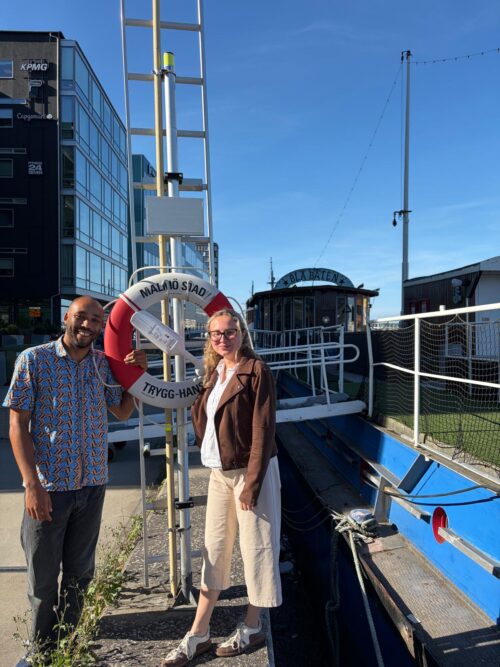
From 11-12 August 2026, the Association of Internet Researchers held a Flashpoint Symposium at Malmö University. The symposium, titled “Imagining and Co-creating Methods for Internet Research”, brought interdisciplinary scholars together to reflect on how, as technologies evolve, our relationship to the technological world changes, and so should our methods of studying it. The symposium invited attendees to question and challenge many of the dominant methodological approaches and to find ways to reimagine methods (…)
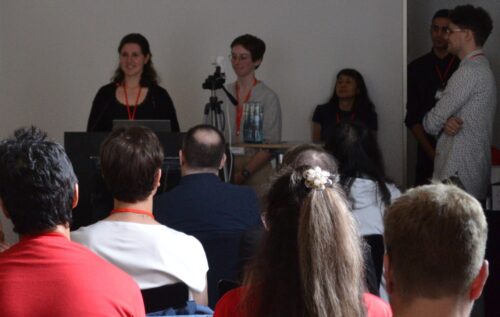
From July 21 to 24, 2026, the ACM Conference on Conversational User Interfaces (CUI 2026) took place in Bremen. The theme of this year’s conference was “Conversational AI: Agency and Identities!” Laura Spillner and Johanna Rockstroh from Project P2 “Interfaces” served as local chairs on the organizing committee and presented their ongoing research there.
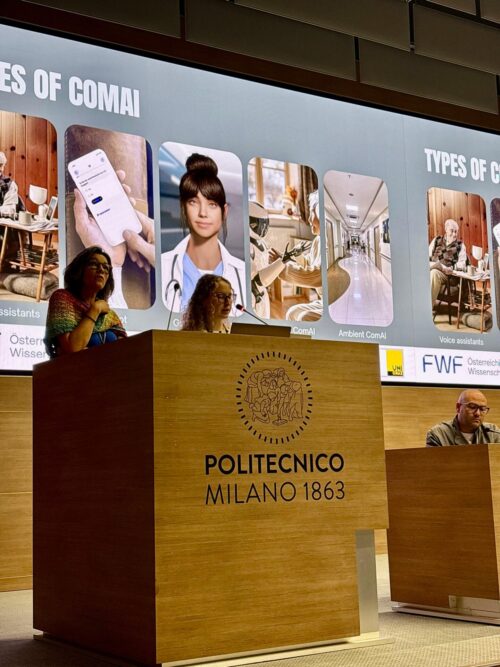
From July 1 to 3, 2026, the Anticipation Conference took place in Milan, bringing together policymakers, researchers, designers, and practitioners to rethink how ideas about the future operate under conditions of uncertainty and unknowing. Juliane Jarke, Ren Aldridge and Sara Skardelly from the P8 project “Health: Caring through ComAI” presented ongoing research. Juliane Jarke and (…)
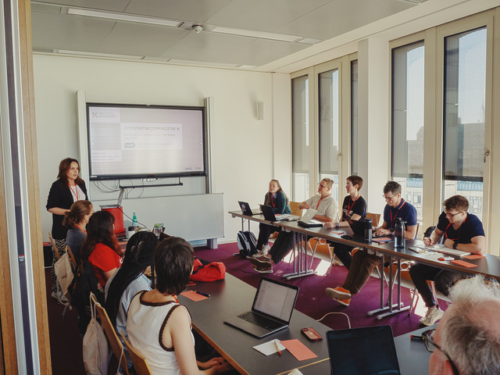
On 21 July, the half-day workshop „ADAPTIC: Adapting Dialog and Pragmatic Traits in Context” took place at the ACM Conversational User Interfaces conference (CUI 2026) in Bremen. It was organised and run by our ComAI colleagues Laura Spillner, Johanna Rockstroh, Paula Goerke, Jule Jensen and Jonah Wermter, with contributions from Sara Skardelly, Leonie Winterpacht, Nima (…)
The recent security incident involving OpenAI and Hugging Face has sparked an international debate about the safety of autonomous AI agents. In an interview with Helmut van Rinsum of Horizont, Andreas Hepp analyzes the events and discusses their technical, societal, and regulatory implications. Among other topics, the conversation covers the nature of the incident, how (…)
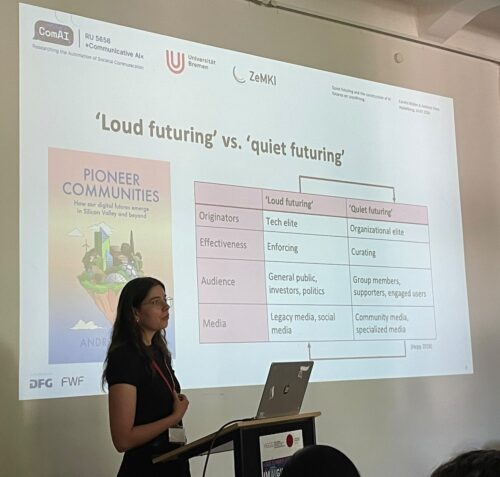
From 16–17 July 2026, the Heidelberg Graduate School for Humanities and Social Sciences held their annual Summer Forum. This year, the theme of the conference was “ImA(I)gining the Future: How Digital Technologies Rewrite Our World.” Selim Başoğlu and Carolin Müller of the project P1 “Pioneer Communities” both presented ongoing research there. Selim Başoğlu’s talk, titled (…)
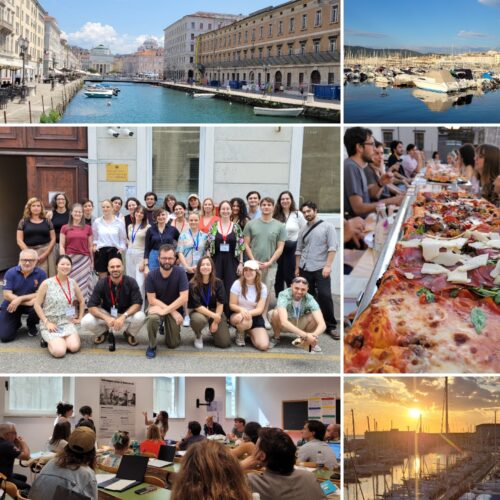
ComAI member (P8) Juliane Jarke took part in a summer school “AI and the future of healthcare” from 7th to 10th July 2026 in Trieste. The summer school was organised jointly by the national Science and Technology Associations: STS Italia and STS Austria. It included participants (PhD and PostDoc-level) from across Europe, Brazil, US and Japan. Juliane (…)
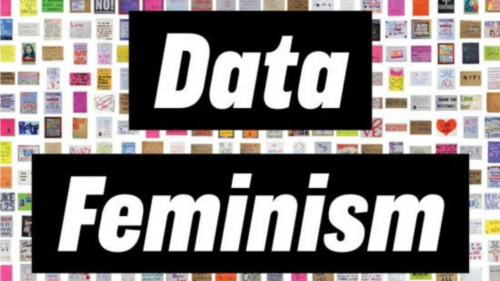
On Thursday, September 3, at 4:00 p.m., the Diversity & Gender Equality Working Group of the ComAI Research Group invites you to a book presentation of “Data Feminism” as part of its internal lecture series. Together with Prof. Lauren F. Klein (Emory University, USA), the book’s co-author, we would like to discuss the role of data (…)
What does “healthy” aging mean as conversational AI becomes an increasingly common part of everyday life? And how are older adults currently engaging with health technologies and envisioning their futures as they age? To address these and other topics, Leonie Winterpacht from P8 “Health” presented at two consecutive international conferences: the 55th Annual Conference of (…)
What should our digital future look like? Juliane Jarke explores this question in an article published on May 30, 2026, in Die Presse. As part of the Graz Sociodigital and Participatory Futures Studio, young people and older adults are developing their own visions of the future in workshops. The results show that many people want (…)
Is it surprising to someone who researches AI in journalism that readers can’t say for sure whether a text was written by a human or an AI? No, not really. Antonia Eichenauer from the P5 project “Journalism: Automating the News and Journalistic Autonomy” answered these and other questions on July 13, 2026, on the morning (…)
13. July 2026
Contact:
Prof. Dr. Andreas Hepp
ZeMKI, Center for Media, Communication and Information Research
University of Bremen