The prevalence of speech assistants taking orders, social bots influencing debates, and machines generating texts underscores the increasing sophistication of automated communication. Simultaneously, public discourse on these phenomena reflects the ongoing challenges associated with the automation of communication. It seems that the intricacies of today’s complex societies compel a reliance on automation to meet communication needs, while also generating additional issues for which automated communication appears to be the most plausible solution.
Research in nine projects plus coordination project
The “Communicative AI“ Research Unit, funded by the DFG and the FWF, is investigating in nine projects and one coordination project how societal communication changes when communicative AI becomes part of it. Top researchers from the fields of media and communication studies, informatics, sociology and law are involved. The research focuses on pioneer communities, the development of interfaces, the legal handling and governance of communicative AI, its role in journalism, in public (online) discourse, in everyday personal life through technological companions, in the health sector and in learning and teaching.
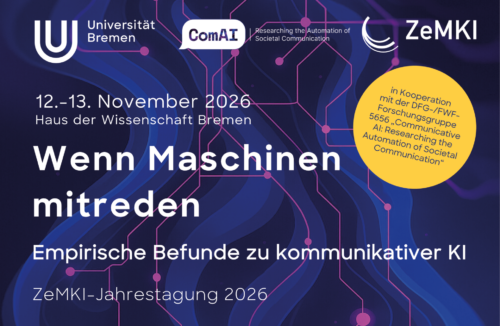
ZeMKI Annual Conference · 12–13 November 2026 · Haus der Wissenschaft Bremen ChatGPT, Claude, Gemini and similar systems no longer just mediate communication. They take part in it themselves: they write texts, hold conversations and act as counterparts. What does this mean for societal communication as a whole? At this year’s ZeMKI Annual Conference, our (…)
The latest episode of BredowCast, the podcast of the Leibniz Institute for Media Research | Hans-Bredow-Institut (HBI), features our research unit. It was recorded around the ComAI Summer Retreat on 5–6 October and the subsequent Summer School from 7 to 9 October at the HBI in Hamburg, where researchers from all nine projects came together. (…)
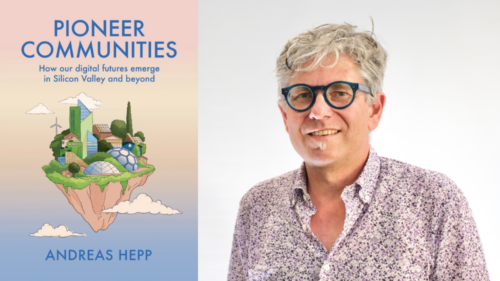
For the 10th HumAIn Talks at the University of Oslo, ZeMKI Speaker Prof. Dr. Andreas Hepp will give a talk on Silicon Valley, pioneer communities, and AI futures this coming Friday, October 23. About the Talk Where do Silicon Valley’s visions of the AI future come from? A superficial answer to this question is: from (…)
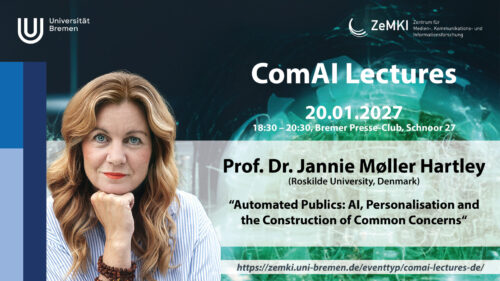
Date: 20. January 2027 Time: 18:30 Street: Domshof 26, 28195 Bremen (Universität Bremen) Location: Forum im Domshof Room: Kassenhalle Abstract Shared matters of concern are fundamental to democratic life. Publics do not simply exist; they form around problems, controversies and consequences that come to matter. As Marres succinctly puts it: “no issue, no public.” But what happens when the conditions (…)
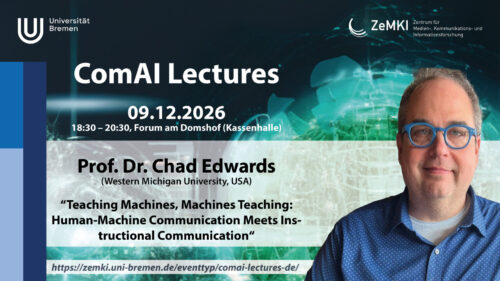
Date: 9. December 2026 Time: 18:30 Street: Domshof 26, 28195 Bremen (Universität Bremen) Location: Forum im Domshof Room: Kassenhalle Abstract Can a robot teach a class? Can a chatbot earn a student’s trust? For over a decade, our research has put machines in the teacher’s chair: a bot answering health questions on Twitter, a telepresence robot delivering a business lecture, (…)
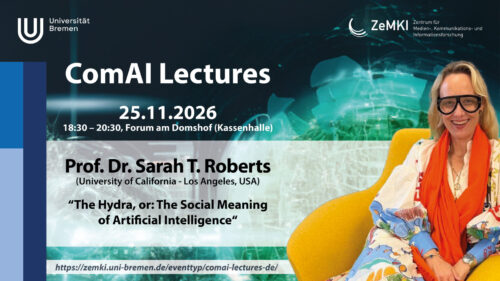
Date: 25. November 2026 Time: 18:30 Street: Domshof 26, 28195 Bremen (Universität Bremen) Location: Forum im Domshof Room: Kassenhalle Abstract In this talk, I describe and contextualize so-called “AI” by addressing, then quickly moving on from, its origins, technological underpinnings and specificities and turn to its deployment and rhetorical social and political dimensions and functions. For that, I introduce the (…)
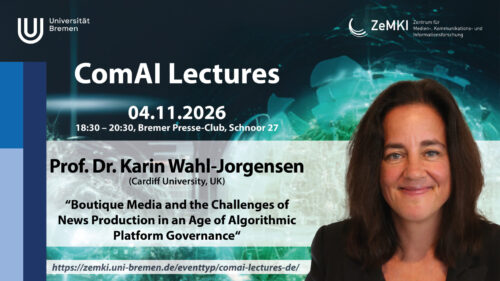
Date: 4. November 2026 Time: 18:30 Street: Domshof 26, 28195 Bremen (Universität Bremen) Location: Forum im Domshof Room: Kassenhalle Abstract In this presentation, I introduce and develop the concept of boutique media to describe small-scale, personality-driven and affectively charged forms of journalism emerging in the wake of the decline of industrial news production. The presentation examines how journalists and other news creators (…)
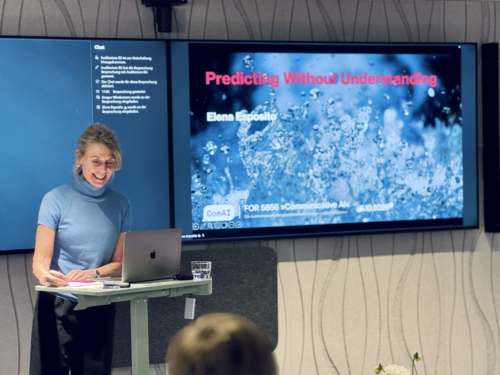
On 5 October 2026, sociologist Elena Esposito gave a ComAI Lecture as part of the research group’s meeting at the Leibniz Institute for Media Research | Hans-Bredow-Institut (HBI). Prediction is the core principle of generative AI, yet we still lack a theory of prediction. Starting from this observation, Esposito asked what it means when algorithms (…)
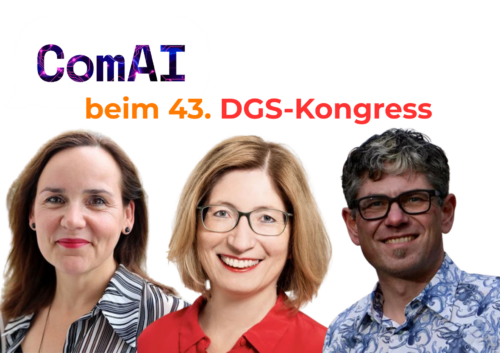
From September 28 to October 2, 2026, the 43rd Congress of the German Sociological Association took place at Johannes Gutenberg University in Mainz. The congress focused on the theme “Futures of Society”. The projects conducting research on ComAI in Pioneer Communities (P1), Journalism (P5) and in the personal sphere (P7) presented empirical research findings at the (…)
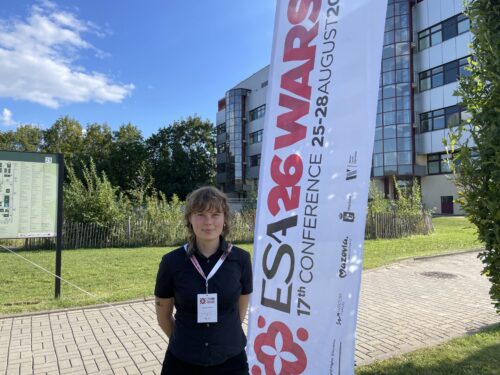
In August, Andrea Heisse (P7) presented her PhD research at the 17th ESA conference in Warsaw. Artificial intelligence receives increasing attention from the sociology of professions, raising questions about the algorithmic capacity to make knowledge claims, take over professional tasks, and implicate professional autonomy. In her presentation, Andrea approached these questions, drawing on empirical insights (…)
On 18 September 2026, ComAI PI Christian Katzenbach delivers a keynote at the 11th Annual Conference of the Kulturwissenschaftliche Gesellschaft (KWG), titled “Kritik und Kultur” (Criticism and Culture; 16–19 September 2026, Berlin). His talk is part of the panel “Argumentieren und Erzählen mit KI: Narrative, Rhetoriken und epistemische Praktiken in kommunikativen Aushandlungen” (Arguing and narrating (…)
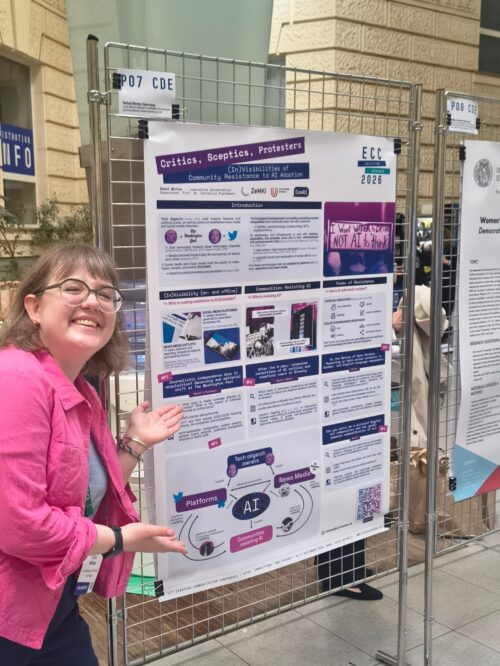
Rahel Winter won the Best Poster Award at the 11th European Communication Conference (ECC 2026) in Brno. The award was presented during the poster session for early-career researchers, organized by YECREA, the ECREA Young Scholars Network. The audience voted, and Rahel’s poster on her dissertation project about resistance to AI received the most votes. Rahel (…)
14. September 2026
Contact:
Prof. Dr. Andreas Hepp
ZeMKI, Center for Media, Communication and Information Research
University of Bremen