Featured on BredowCast: How is journalism appropriating AI?
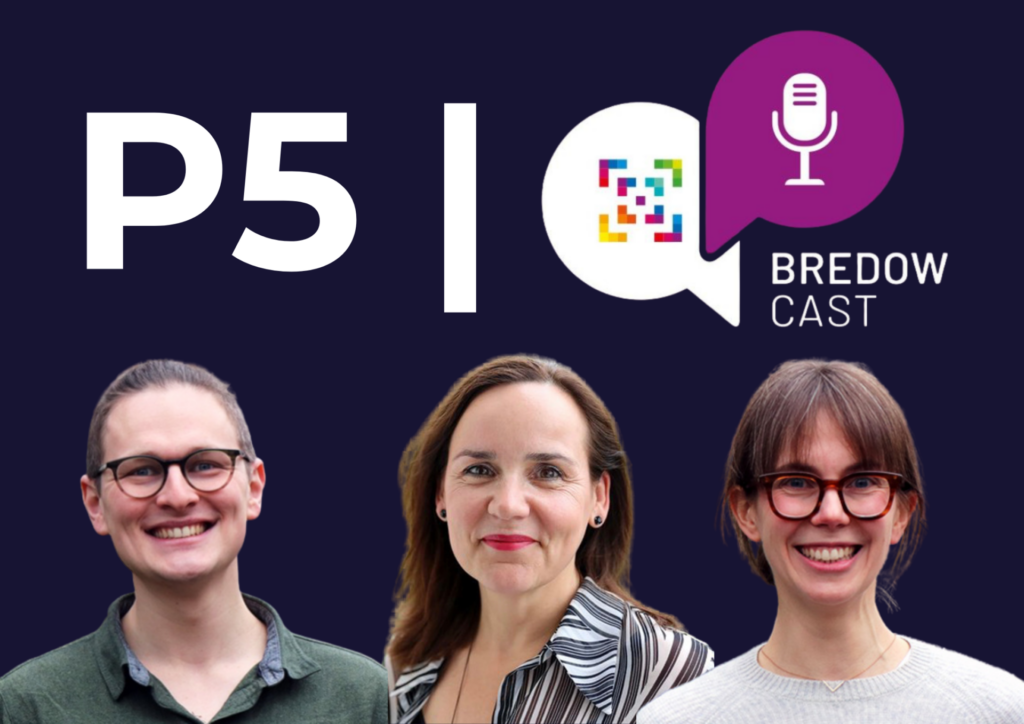
Our project P5 “Journalism: The Automation of News and Journalistic Autonomy” has been featured on the BredowCast, the academic podcast of the Leibniz-Institute for Media Research | Hans-Bredow-Institute. Hosted by Kristina Kobrow, Prof. Dr Wiebke Loosen, Antonia Eichenauer and Jonah Wermter discuss findings from their first year of research.
At the heart of the project’s research – and indeed the podcast – lies the concept of appropriation. This encompasses more than the mere technical use of communicative AI; rather, it describes the reciprocal, active process underlying the way in which actors make use of a technology. In the course of communicative interaction with AI, production methods, standards and even the self-image of journalism can change.
This ties in with the concept of agency, which, in the broadest sense, describes the capacity and power of journalists to act. What is meant is the freedom to bring one’s own will to bear and to help shape how AI is used. The podcast was unable to address all facets and questions of agency in relation to the appropriation of AI. The discussion focuses on how agency, always embedded within organisational and societal structures, will change against a backdrop of increasing economic pressure, technological developments and organisational requirements.
Another topic is the ambivalent picture that emerges from the findings of the group discussions with journalists: on the one hand, there is the idealised notion that AI could take on repetitive or burdensome tasks, whilst the ‘actual’ core journalistic tasks remain with humans. On the other hand, there are serious concerns: those who leave rephrasing, wording and entire thought processes to the machine – such as a Large Language Model (LLM for short) – may (!) indeed work faster, but also risk a loss of autonomy and a shift in quality standards, away from the question of when a text is good, towards the question of when a text is good enough. This ambivalence is encapsulated in a striking quote from the discussions: “I fear I am unscrewing my own brain.” This reflects the fear that AI systems do not merely provide assistance, but in the long term may shift capabilities, alter working methods and thereby also redefine journalistic autonomy and roles.
A process of normalisation that is transforming journalistic workflows is already underway. However, exactly how journalism will have changed by 2028 – when the research project concludes – remains to be seen. In this context, the tension between technical feasibility and ‘cultural inertia’ must be taken into account, as must the continuously shifting focus of the debate: Whereas the issue of labelling was at the forefront last year, the topic of trust is now increasingly taking centre stage.
The BredowCast is the science podcast from the Leibniz-Institute for Media Research | Hans-Bredow-Institute. Once a month, presenter Kristina Kobrow talks to researchers from the institute about what they are currently investigating and what everyday life at the HBI is like. The podcast is recorded in German.
Listen to more in this topic in the BredowCast Episode “BRC111 Wie eignet sich der Journalismus KI an?”
22. April 2026

Contact:
Prof. Dr. Andreas Hepp
ZeMKI, Center for Media, Communication and Information Research
University of Bremen
Phone: +49 421 218-67620
Assistent Mrs. Schober: +49 421 218-67603
E-mail: andreas.hepp@uni-bremen.de