ComAI Research Group at the 43rd DGS Conference
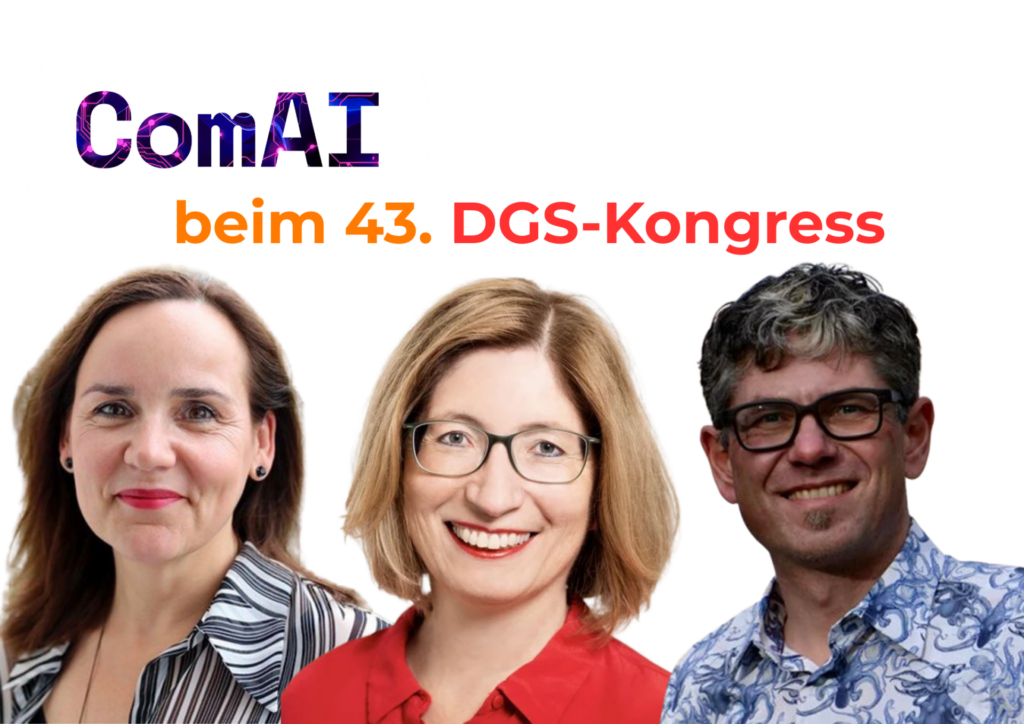
From September 28 to October 2, 2026, the 43rd Congress of the German Sociological Association took place at Johannes Gutenberg University in Mainz. The congress focused on the theme “Futures of Society”. The projects conducting research on ComAI in Pioneer Communities (P1), Journalism (P5) and in the personal sphere (P7) presented empirical research findings at the conference.
Prof. Dr. Andreas Hepp (P1) will deliver the presentation “From ‘Quiet’ to ‘Loud’ Futuring: Silicon Valley, Pioneer Communities, and the Cultural Dynamics of Creating AI Futures.”:
Where do Silicon Valley’s visions of the AI future come from? A superficial answer to this question is: from “Big Tech” and the “Tech Bros.” However, a more in-depth analysis is necessary to grasp the cultural dynamics of AI-related futuring and the inequality and power it rearticulates. In my presentation, I aim to show that Big Tech’s “loud futuring” incorporates the visions of “quiet futuring” from technology-oriented groups in and around Silicon Valley into broader societal imaginaries. Thus, many of today’s AI futures stem from the Whole Earth Network, Effective Altruism, and other Pioneer Communities. Drawing on an ethnographic study comprising 321 interviews as well as analyses of the Silicon Valley Archives, I trace these cultural dynamics and discuss their theoretical significance.
The presentation is divided into three parts. In the first, I examine the dynamics of “quiet” and “loud futuring”: I show to what extent the future visions of Pioneer Communities serve as a fundamental resource for Big Tech’s “loud futuring”—and how Big Tech, at the same time, provides a framework for the future discourse of Pioneer Communities. In the second part, I reconstruct AI-related visions of the future spanning three generations: from “cybernetic futures” (futures of self-organizing society) through “agile futures” (futures of digital agile capitalism) to contemporary “slippery futures,” in which techno-solutionism and existential threat converge. The third part offers a sociotheoretical reflection: the unprecedented concentration of capital accelerates the implementation of certain visions of the future, and the attribution of agency to AI transforms knowledge practices in academia and the professional world.
For sociology, this means analyzing the emergence of technology in relation to projections, visions, and imaginaries of futures—and not only once the relevant technologies have had a broad societal impact.
Prof. Dr. Wiebke Loosen (P5) and Prof. Dr. Michaela Pfadenhauer (P7) will present their joint talk titled “Societal Futures of Communicative AI: Expropriative Appropriation in Journalism and Companion App Technologies.”:
Communicative AI is considered the technology of the future par excellence. Its future-oriented character is virtually tangible: as cultural imagination, as a technological principle, as structurally embedded potential that legitimizes present-day actions. Nevertheless, this future-oriented character remains elusive, a fact linked to the structural characteristics of communicative AI: what it is does not emerge prior to appropriation, but rather through it. Different processes of appropriation do not produce different ways of using the same system, but rather different communicative AIs and thus different communicative realities that emerge within social structures, which we refer to as hybrid figurations. Which societal futures communicative AI brings about is therefore not technologically predetermined, but is produced through processes of appropriation.
Appropriation does not occur in just one direction—we distinguish three modes: “Appropriation of ComAI” describes how actors integrate and reshape communicative AI into domain-specific practices. “Appropriation through ComAI” focuses on the fact that communicative AI becomes a mediating entity through which actors appropriate something that lies beyond ComAI itself. “Appropriation by ComAI” refers to the structural process in which communicative AI, as a rhizomatic, opaque infrastructure, takes up and transforms practices, forms of knowledge, and communicative patterns from various domains.
This intertwining represents a structural pattern that we refer to as “dispossessive appropriation”: The appropriation of communicative AI structurally carries within it potential moments of dispossession—of one’s own agency, one’s own irreplaceability, and one’s own power to define. This is not a side effect of appropriation but manifests as a pattern that distinguishes the appropriation of communicative AI from the appropriation of earlier media technologies.
In this presentation, we will elaborate on this understanding of the appropriation of communicative AI and apply it to our empirical research on journalism and the use of companion apps in everyday life, which we are currently conducting as part of the DFG/FWF research group “Communicative AI.”
Marvin Waibel, Andrea Heisse, and Michaela Pfadenhauer (P7) presented the talk “AI Companions – On the Co-Construction of Digital Personas, Digital Relationships, and Digital Worlds” in the Ad Hoc Group 23, “Digital Futures of the Person: Changing Relationships Between Humans and Generative Artificial Intelligence.”
The ComAI members presented initial findings from walkthroughs of AI companion apps, analyses of chats between AI companion users and their AI companions, and interviews with users. They discussed the extent to which app design facilitates the development of a digital persona and the explication of one’s own personality, as well as how symmetries and asymmetries are negotiated in chat interactions. Furthermore, the researchers highlighted the meanings users ascribe to their AI companions, their relationship with them, and the world they are building.
Antonia Eichenauer, Wiebke Loosen and Jonah Wermter (P5) were part of the Panel “Future Expectations and Their Consequences in Science, Technology and Society” organised by the Section on the Sociology of Science and Technology.
Their presentation “Anticipatory Appropriation and the Open Question: What is AI for Journalism?” focused on the future imaginations that guide the appropriation of AI in journalism. Drawing on the first editorial ethnography, group discussions and expert interviews, they highlighted emerging patterns of appropriation. Particular interest sparked the question of what role journalists will have in the future.
Further details on both presentations can be found here.
1. October 2026

Contact:
Prof. Dr. Andreas Hepp
ZeMKI, Center for Media, Communication and Information Research
University of Bremen
Phone: +49 421 218-67620
Assistent Mrs. Schober: +49 421 218-67603
E-mail: andreas.hepp@uni-bremen.de