Pioneer Communities and the Future of AI in China: Why OpenClaw in Shenzhen is also about the One-Person Company
A blog post by Andreas Hepp
Visions of possible futures with AI appear to vary significantly across different cultural contexts. In Silicon Valley and its pioneer communities, these visions are heavily driven by the possibilities of “Artificial General Intelligence” (AGI) or “superintelligence” and the challenges of “AI safety,” as we are currently investigating through media ethnography and an analysis of the LessWrong forum. This fits into broader societal imaginaries in the U.S., according to which AI will shape the future of the economy, and targeted support for major corporations in this field is seen as a means to expand the country’s dominance. In discussions about an “AI race” (Bareis & Katzenbach, 2022), China is often presented as a “counter-model”, but upon closer inspection, there are numerous parallels. This became evident during a research visit in April 2026 to Shenzhen, the Chinese special economic zone adjacent to Hong Kong.
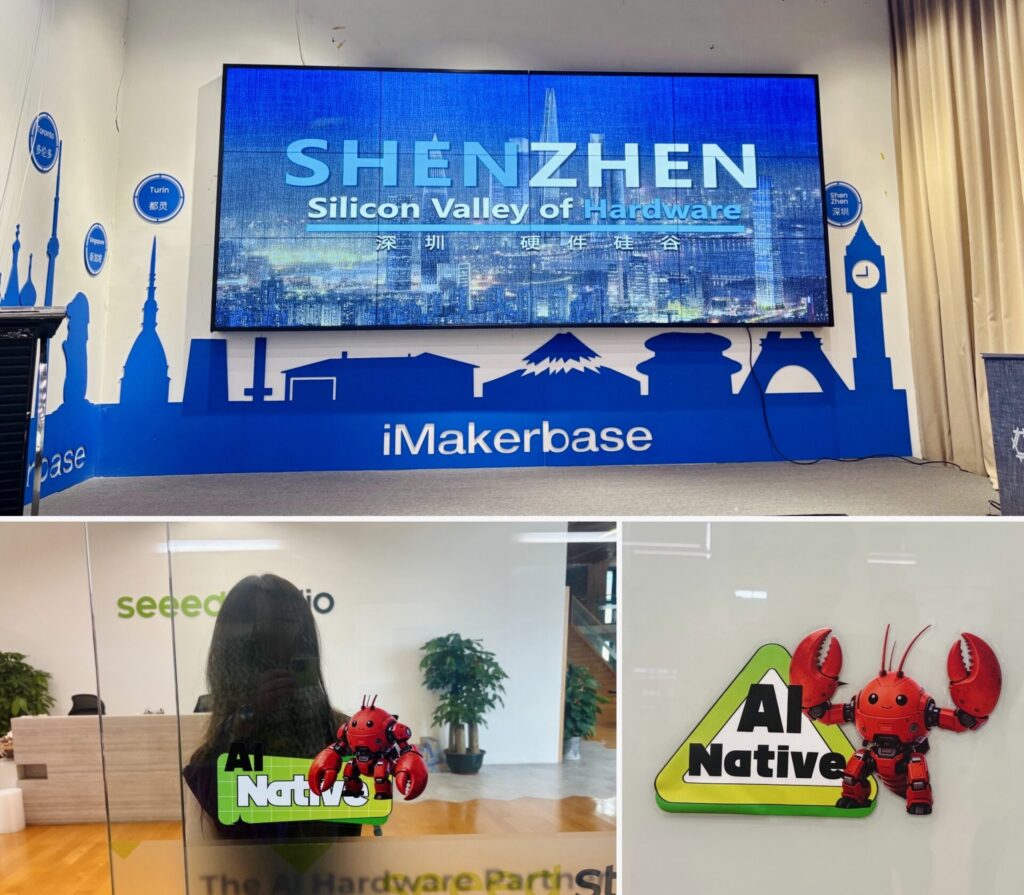
During my research stay, I had the opportunity to visit various makerspaces and related corporations, such as “Seeed Studio”, which manufactures hardware for maker projects and also exhibited at re:publica in Berlin in May 2026. The red lobsters of OpenClaw, accompanied by the slogans “AI Native” and “AI First,” were impossible to miss. At first glance, this can be seen as a reflection of the OpenClaw boom in China, which was also widely covered by the European press. The unique feature of OpenClaw, this “open agent platform” (https://openclaw.ai/blog/introducing-openclaw)—developed by an Austrian programmer who now works at OpenAI—is, on the one hand, that it allows for the easy development of standalone AI agents. On the other hand, it can be used with language models from various providers, including not only those from OpenAI and Anthropic but also Chinese models such as Kimi (Moonshot AI) and MiniMax. OpenClaw’s concept thus aligns with the Chinese government’s policy of prioritizing open source in AI development. OpenClaw is regarded there as “the AI era’s answer for ordinary people” (https://www.bbc.com/news/articles/cy41n17e23go).
However, my observations in Shenzhen also show that this is only part of the story. In fact, just as often as OpenClaw, one encounters something else in these spaces: the concept of the “one-person company” (OPC—Chinese: 一人公司). OPC does not simply refer to the legal form of a company with a single shareholder (the establishment of which has been simplified in China since 2024). Since at least the beginning of 2026, the term OPC has been associated with the Chinese national policy vision of a new organizational paradigm for innovative micro-enterprises in the AI era: AI agents can take on the tasks of entire teams, organize marketing, sales, and much more, thereby enabling a single person to run a one-person company. OpenClaw thus becomes a tool that not only integrates Chinese AI models, but also makes it possible to realize this vision of the OPC on a broad scale. Open-source visions originating in (in this case, US and European) pioneer communities and tech movements thus become part of the materialization of state innovation policy.
We can view this as the current manifestation of a much longer-running development: For instance, the visions of the Silicon Valley-based Maker movement—which sought to “innovate” the economy through experimental makerspaces—were taken up in China’s official innovation policy, a dynamic that Silvia Lindtner conceptualizes as the rise of a “prototype nation” (Lindtner, 2020, see also Fu, 2026; Wen, 2017). We can already see here the transcultural intermeshing of “quiet” and “loud futuring” (Hepp, 2026). “Quiet futuring” refers to visions of the future from pioneer communities such as the Maker movement, which are primarily directed at their members and interested parties. These are then taken up in the “loud futuring” of corporations and state actors—such as, in this case, the Chinese government—which is directed at the general population and represents an attempt to construct an overarching, technology-related societal imagination of the future, referred to in research as the “sociotechnical imaginary” (Jasanoff, 2015: 24).
The OpenClaw boom in China fits into this pattern. The “open agent platform” has thus become the central tool through which the vision of a national Chinese AI innovation policy is taking shape. In this way, the OpenClaw boom is closely linked both to the local context and to the loud futuring of national innovation policy. Locally, this includes support from China’s tech giants. In Shenzhen, for example, Tencent—operator of WeChat and one of the city’s major companies—has organized public events to help even people with little technical background install OpenClaw. Many of the people I spoke with during my stay in Shenzhen mentioned this, as well as the opportunity to purchase low-cost mini PCs with OpenClaw pre-installed. At the same time, there is also government funding: For instance, the authorities in Shenzhen’s Longgang District have announced measures to build an ecosystem around OpenClaw aimed at promoting “one-person companies.” At the same time, however, several Chinese national bodies—technical cybersecurity agencies (CNCERT, NVDB/MIIT), the State-owned Assets Supervision and Administration Commission (SASAC), the Ministry of State Security (MSS), the central bank (PBoC), and a number of universities—have issued warnings about improper installation, data leaks, and unintended AI agent behaviour, and in several cases have partially banned the software within institutions under their oversight, including state-owned banks, government agencies, and university campuses.
Overall, the OpenClaw example illustrates several points: First, it shows that even in China, there is a close interplay between the “quiet futuring” of pioneer communities and the “loud futuring” of state actors and Big Tech. Second, it demonstrates that this interplay is transcultural; that is, just as (American) maker visions were previously incorporated into Chinese state innovation policy, the same now applies to (European) notions of the desired “openness” of AI agents. Third, we cannot understand these dynamics as a simple “top-down” process; rather, the interrelationships are more complex.
All of this, however, points to a continuation of the concept of a “prototype nation”—not only in the sense that China, by adopting methods such as technological prototyping, aims to evolve from a “workbench” into a country of innovation hubs. It is also about seeing itself as the “prototype” of a different kind of successful nation—beyond Western democratic models. And this, in turn, points back to the very core of the “AI race.”
References:
Bareis, J., & Katzenbach, C. (2022). Talking AI into being: The narratives and imaginaries of national AI strategies and their performative politics. Science, Technology & Human Values, 47(5), 855-881.
Fu, P. (2026). Maker culture in China: Agile innovators between state and market. London: Palgrave.
Hepp, A. (2026). Pioneer communities. How our digital futures emerge in Silicon Valley and beyond. Cambridge: Polity (in production).
Jasanoff, S. (2015). Future imperfect. Science, technology, and the imaginations of modernity. In S. Jasanoff & K. Sang-Hyun (Eds.), Dreamscapes of modernity. Sociotechnical imaginaries and the fabrication of power (pp. 1-33). Chicago: Univ. of Chicago Press.
Lindtner, S. M. (2020). Prototype nation. Princeton: Princeton University Press.
Wen, W. (2017). Making in China: Is maker culture changing China’s creative landscape? International Journal of Cultural Studies, 20(4), 343-360.
9. June 2026

Contact:
Prof. Dr. Andreas Hepp
ZeMKI, Center for Media, Communication and Information Research
University of Bremen
Phone: +49 421 218-67620
Assistent Mrs. Schober: +49 421 218-67603
E-mail: andreas.hepp@uni-bremen.de