The prevalence of speech assistants taking orders, social bots influencing debates, and machines generating texts underscores the increasing sophistication of automated communication. Simultaneously, public discourse on these phenomena reflects the ongoing challenges associated with the automation of communication. It seems that the intricacies of today’s complex societies compel a reliance on automation to meet communication needs, while also generating additional issues for which automated communication appears to be the most plausible solution.
Research in nine projects plus coordination project
The “Communicative AI“ Research Unit, funded by the DFG and the FWF, is investigating in nine projects and one coordination project how societal communication changes when communicative AI becomes part of it. Top researchers from the fields of media and communication studies, informatics, sociology and law are involved. The research focuses on pioneer communities, the development of interfaces, the legal handling and governance of communicative AI, its role in journalism, in public (online) discourse, in everyday personal life through technological companions, in the health sector and in learning and teaching.
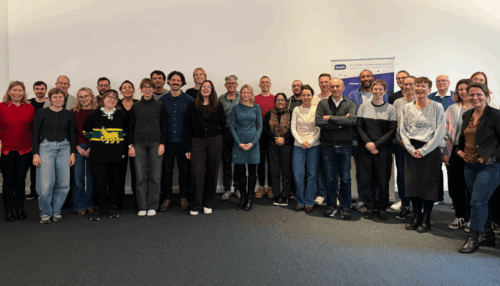
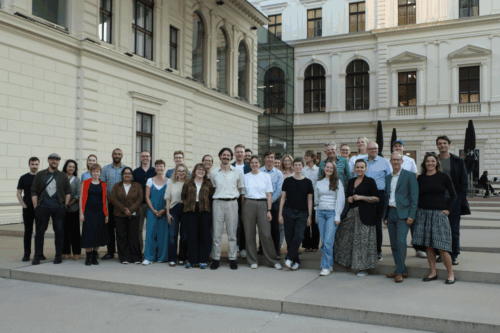
On November 10, 2025, the research group Communicative AI (ComAI) held its quarterly meeting at the Haus der Wissenschaft in Bremen. The focus was on an exchange with Prof. Dr. Andrea L. Guzman (Northern Illinois University), currently a visiting scholar at ZeMKI, as well as on planning the group’s joint publications for the coming year. (…)
Date: 25.11.2025 Time: 18:30 Street: Schnoor 27 Location: Bremer Presse-Club Abstract AI promises speed, efficiency, and seamless automation, yet in pursuing these ideals, we risk marginalizing practices and temporalities that matter: slowness, reflection, imperfection, and the capacity to linger. This talk reframes the conversation about AI futures by focusing not only on what is to come, but on what (…)
An article by Prof. Dr. Andreas Hepp entitled “Approaching digital futures: why media and communication research needs to move from a perspective of consequence to one of emergence” was recently published in the International Communication Association journal “Communication Theory”. In the article, Andreas Hepp makes it clear that communication and media studies should focus more (…)
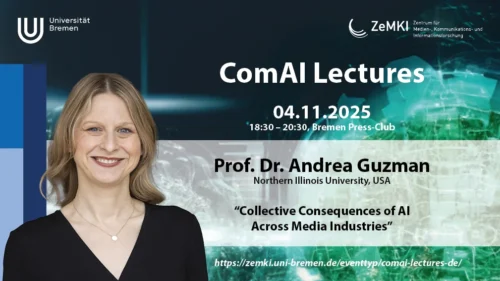
On November 4, 2025, Prof. Dr. Andrea L. Guzman (Northern Illinois University), visiting scholar at the ZeMKI, held a lecture at the Bremer Presse-Club as part of the ComAI Lectures series. In her talk, “Collective consequences of AI across media industries,” she traced the evolution of research in Human-Machine Communication (HMC) and discussed the challenges (…)
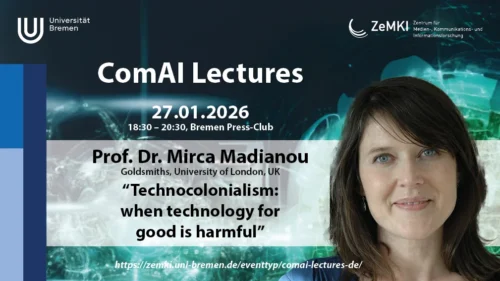
Date: 27. January 2026 Time: 18:30 Street: Schnoor 27 Location: Bremer Presse-Club Abstract With over 300 million people in need of humanitarian assistance and with emergencies and climate disasters becoming more common, AI and data are being championed as forces for good and as solutions to the complex challenges of the aid sector. In this talk based on my (…)
Date: 4. November 2025 Time: 18:30 Street: Schnoor 27 Location: Bremer Presse-Club Abstract This talk examines the shared implications of emerging AI technologies across media industries. Advancements in generative artificial intelligence are bringing rapid changes to communication industries. AI applications can perform increasingly human-like roles in the communication process and, as such, can augment and even automate human media (…)
The latest issue of Aviso – the journal of the German Communication Association (DGPuK) – features a debate entitled “Communication science at a turning point? How AI is turning the academic world upside down” on the question of what the spread of AI means for communication and media studies. Two project managers from the “Communicative (…)
A new article by Noortje Marres, Christian Katzenbach, Anders Kristian Munk, and Anna Jobin has been published in Big Data & Society. Serving as the introduction to the Special Issue “Analysing Artificial Intelligence Controversies?”, the paper explores how public controversies around artificial intelligence shape — and are shaped by — broader social tensions. The authors (…)
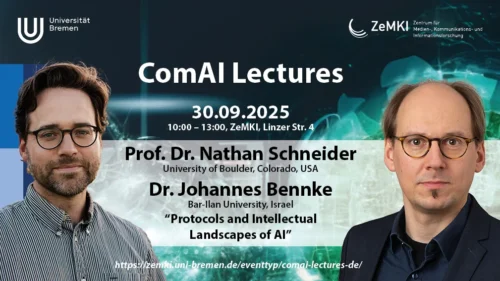
On September 30, Prof. Dr. Nathan Schneider (University of Boulder, Colorado, USA) and Dr. Johannes Bennke (Bar-Ilan University, Israel) visited ZeMKI for the ComAI lecture Protocols and Intellectual Landscapes. Together with ComAI spokesperson and ZeMKI member Prof. Dr. Andreas Hepp the workshop discussed the concepts of protocological governance and intellectual landscapes of AI in a joint, theoretical investigation. Protocols (…)
The ComAI subproject “Personal sphere: Companionship and ComAI” (P7) presents its initial findings at this year’s congress of the German Sociological Association at the University of Duisburg-Essen (September 22–26, 2025). In the Adhoc group “Actors without Humans – Conceptualization and Consequences of Non-Human Agency,” Marvin Waibel, Andrea Heisse, and Michaela Pfadenhauer introduce a conceptualization of the agency of communicative (…)
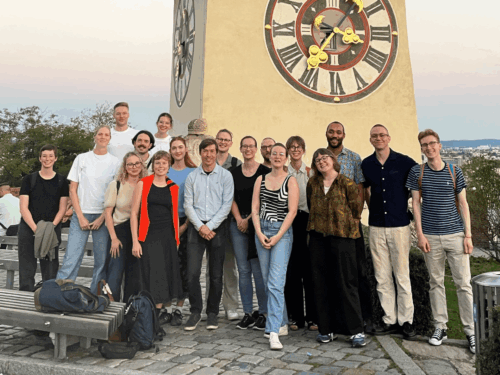
From 17 to 19 September 2025, the annual ComAI Summer School took place in Graz, following the research group’s retreat. The event began with poster presentations in which all doctoral researchers pitched the current state of their dissertation projects in short talks. Afterwards, they received focused feedback from PIs of other subprojects during an open (…)
From 15 to 17 September 2025, our Research Unit met for its first multi-day annual research retreat, followed by the doctoral researchers’ summer school. The meeting took place at the project site in Graz, Austria. The focus this time was on methodological questions: How can concepts such as alignment or appropriation be made comparable across (…)
21. September 2025
Contact:
Prof. Dr. Andreas Hepp
ZeMKI, Center for Media, Communication and Information Research
University of Bremen