More than AI Safety: What the Export Ban on Anthropic’s Fable 5 and Mythos 5 Reveals about Global Power Geometries
A blog post by Andreas Hepp
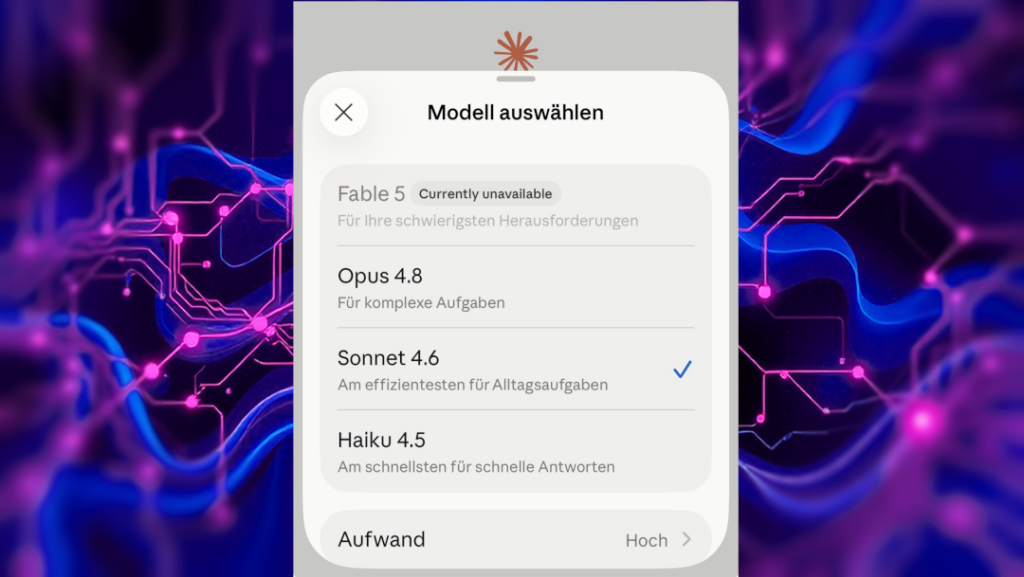
Anyone who, as a non-American, currently wants to work with Anthropic’s latest language model, Claude Fable 5, has, since Saturday German time, been receiving the message that the model is “currently unavailable.” Behind this lies an export control imposed by the US government, under which all foreign nationals are denied access to Anthropic’s two latest models, regardless of whether they are inside or outside the United States, including Anthropic’s foreign employees, as the company’s website states. Besides Fable 5, this also affects Mythos 5, the model that has been the subject of broad media coverage in recent weeks because it can uncover security vulnerabilities in the software of banks, public authorities, and other relevant societal infrastructure.
If one follows public discussions, the trigger was a report by Amazon about a jailbreak in which Fable 5 is said to have been used. Accordingly, the export control would have been issued for security reasons. But the case also stands for something more, namely the question of how AI risks can be minimized. And here there are indeed differing positions within the Silicon Valley world of “AI Safety” and its pioneer communities.
Ultimately, two positions are at stake. One reading critical of Anthropic – and of its demarcation from OpenAI as the lab oriented toward “safety” – is that Anthropic is now getting the answer it wanted itself. On several occasions, Anthropic’s leadership has brought into play regulation, a slowdown, or a temporary pause of AI development, most recently because the power of its own models would make it possible for AI to develop itself. From such a view, the American government has introduced a kind of licensing model through the back door – and has thereby taken a step in the right direction.
The other position is that the move via export control is itself problematic, because it does not constitute an explicitly introduced regulatory regime. From such a perspective, the instruments of export control are repurposed, instead of turning questions of AI safety into a dedicated AI regulation. Some interpret the incident as a further step in the conflict between Anthropic and the Trump administration that has been dragging on since February 2026, when the company insisted on two exceptions to the military use of its language models: no fully autonomous weapons and no mass surveillance of US citizens.
Seen in a broader, global context, however, even more is at stake – namely the question of what AI safety means from the perspective of global power geometries. What both perspectives have in common is that questions of AI safety are treated as questions of national security and economic interests, or of the interests of individual companies or labs. But what would it mean if such questions were genuinely negotiated in a global context, especially against the backdrop that models like Anthropic’s are neither used in a single country alone nor have their potential risks stop at national borders?
If one looks at the debate around “AI Safety” in Silicon Valley, it is striking that such questions are hardly ever posed as questions of global justice and the distribution of power, but almost exclusively in the register of national security. Here, even Anthropic’s leadership remains bound to the imaginative landscape of AI prevalent in Silicon Valley and to the notions there of an “AI race” between the US and China, even when it proposes an internationally coordinated slowdown of development. To take global power geometries seriously, however, means more, namely to include the transnational distribution of risks.
14. June 2026
Contact:
Prof. Dr. Andreas Hepp
ZeMKI, Center for Media, Communication and Information Research
University of Bremen
Phone: +49 421 218-67620
Assistent Mrs. Schober: +49 421 218-67603
E-mail: andreas.hepp@uni-bremen.de