Sara Skardelly and Marvin Waibel present at the AoIR Flashpoint Symposium in Malmö
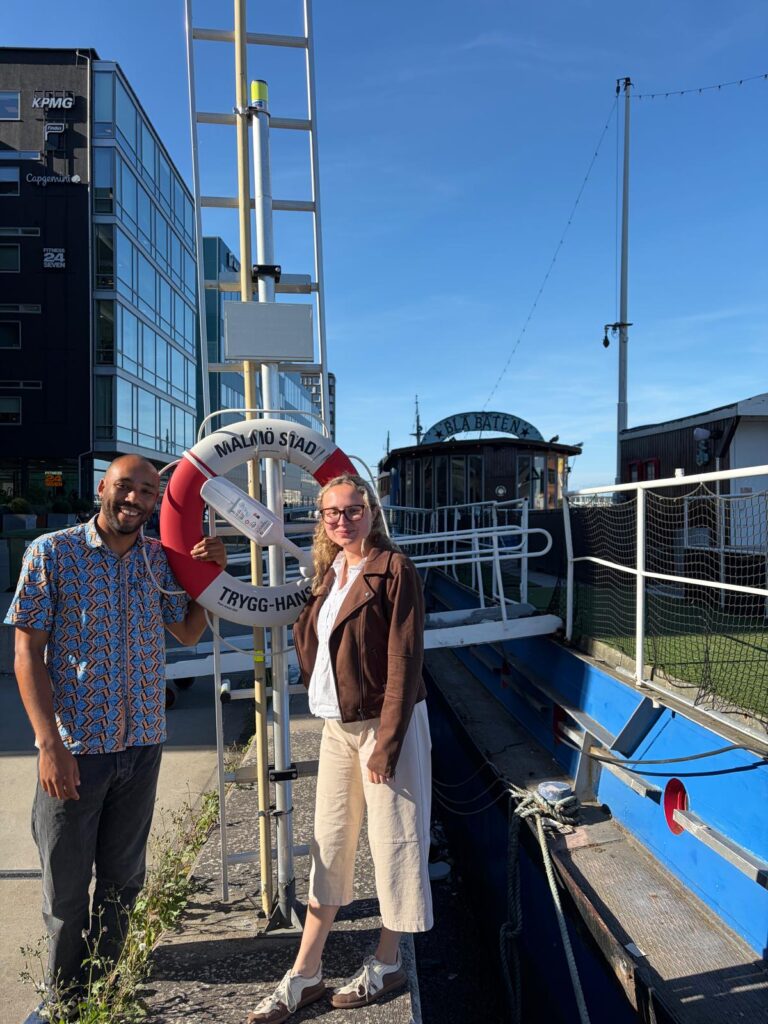
From 11-12 August 2026, the Association of Internet Researchers held a Flashpoint Symposium at Malmö University. The symposium, titled “Imagining and Co-creating Methods for Internet Research”, brought interdisciplinary scholars together to reflect on how, as technologies evolve, our relationship to the technological world changes, and so should our methods of studying it. The symposium invited attendees to question and challenge many of the dominant methodological approaches and to find ways to reimagine methods that addresscontemporary research challenges.
The ComAI Research Unit actively participated in this symposium with two different methodological contributions. Sara Skardelly (P8), together with her colleague Gwendolin Barnard (University of Graz), presented a creative and participatory method they applied in two workshops. Through erasure poetry techniques they co-created “responsible” AI futures inviting professionals to delete, highlight, draw on, and annotate pre-selected text from national policy documents, guidelines, standards, and developer glossaries. In this presentation, Sara and Gwendolin reflected on the broader implications for how internet researchers might use erasure poetry to intervene in anticipatory governance and public discourse around AI.
Meanwhile, Marvin Waibel (P7) presented a preliminary framework for an AI ethnography that actively includes ‘trouble-making’. Following the sociologist Harold Garfinkel and his famous breaching experiments, he presented his own research on AI companions that included creatively arranged interaction sequences. These interaction sequences echo Harold Garfinkel’s early experiments with the pioneering chatbot ELIZA. Marvin designed his own sequences to analyze the emerging communicative patterns of the latest AI companions and reflected on the methodological embeddedness within AI Ethnography, and fostered an open discussion about creativity in AI research, interactionist perspectives, and ethnography – from digital variants to autoethnographic approaches.
18. August 2026
Contact:
Prof. Dr. Andreas Hepp
ZeMKI, Center for Media, Communication and Information Research
University of Bremen
Phone: +49 421 218-67620
Assistent Mrs. Schober: +49 421 218-67603
E-mail: andreas.hepp@uni-bremen.de