Mirca Madianou at ComAI: Digital Identity, Technocolonialism and the Power of Infrastructures
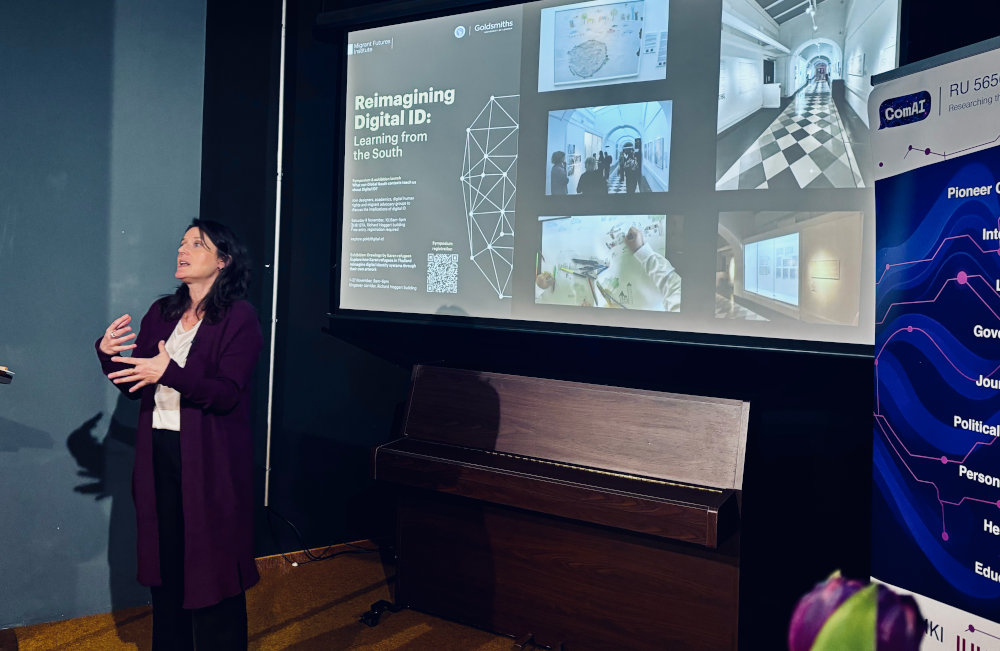
As part of a workshop and an evening ComAI Lecture, media and communication scholar Mirca Madianou visited ZeMKI in Bremen. Across both formats, she presented and discussed key insights from her long-term research on digital technologies in humanitarian contexts, with a particular focus on power asymmetries, infrastructures, and the ethical implications of technological interventions.
The workshop was based on research concerning digital ID technologies, conducted together with Charlotte Hill. At its centre was a biometric identification system implemented in a refugee camp along the Thailand–Myanmar border. Madianou conceptualises this case as an instance of surreptitious experimentation: technological pilots are introduced as part of everyday humanitarian infrastructures rather than being explicitly framed as experiments. As a result, affected populations become test subjects without being informed or able to meaningfully consent. The discussion critically examined digital ID systems as Western-centric concepts that often disregard local contexts and reproduce deep power imbalances. A key element of the workshop was the methodological approach of the study. In addition to ethnographic research, the project employs participatory and artistic methods to capture experiences, concerns and forms of resistance that are difficult to articulate through conventional research instruments. Participants discussed how such artistic workshops are produced, how their outcomes can be analysed, and what kinds of knowledge they generate in research on digital infrastructures.
In the evening ComAI Lecture, Madianou introduced her new book Technocolonialism: When Technology for Good Is Harmful. In this work, she develops the concept of technocolonialism to describe how digital technologies, promoted under the banner of humanitarianism and “technology for good”, often reinforce colonial power relations and structural inequalities. Drawing on examples from more than a decade of research, she showed how digital identity systems, biometric infrastructures, AI-based decision-making and platform technologies can become mechanisms of control, extraction and harm. Central to her argument are six interrelated logics shaping digital humanitarianism: the logic of accountability, the logic of audit, the logic of capitalism, technological solutionism, logics of securitisation, and logics of resistance. Together, these logics help explain how infrastructures diffuse responsibility, normalise experimentation in precarious contexts, and yet also provoke everyday forms of contestation and refusal.
The workshop and lecture provided valuable impulses for the work of our research group, highlighting the importance of critically examining communicative AI systems as sociotechnical infrastructures embedded in global power relations—and of foregrounding the perspectives of those most affected by their implementation.
28. January 2026

Contact:
Prof. Dr. Andreas Hepp
ZeMKI, Center for Media, Communication and Information Research
University of Bremen
Phone: +49 421 218-67620
Assistent Mrs. Schober: +49 421 218-67603
E-mail: andreas.hepp@uni-bremen.de