Workshop: “Arguing Better Online: How AI Can Support Democratic Debates”
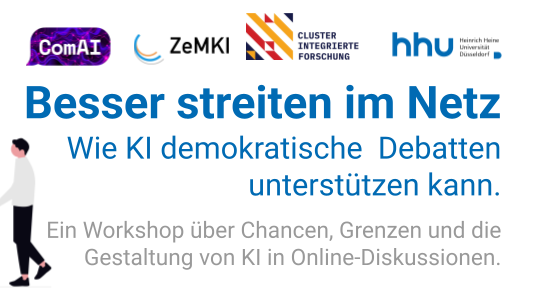
Online discussions are an important part of social dialogue. However, if the quality of a discussion is perceived as low, it can discourage people from participating. Applications based on artificial intelligence (AI) can help break down barriers to participation and make diverse opinions more visible. At the same time, they raise questions, such as those regarding the protection of freedom of speech and responsibility for AI-driven interventions in discussions.
To discuss these and other questions, citizens gathered at the Haus der Universität in Düsseldorf on November 17, 2026, as part of the “Internet Policy and Democracy” action days under the title “Better Online Debates: How AI Can Support Democratic Discussions.” The workshop focused on the opportunities, limitations, and responsible design of AI in online discussions. The event was organized by HHU Düsseldorf, represented by Dr. Maike Behrendt and Viviana Warnken, in collaboration with Patrick Frey from ZeMKI (University of Bremen).
To begin, participants were given an overview of the research projects “Political Discourse: Communicative AI and Deliberative Quality” at the University of Bremen and “Innovative Interventions for Discursive Integration” (INDI) at HHU Düsseldorf. While the Bremen research project, which is part of the ComAI Research Unit, is investigating the potential of social bots to improve the quality of political discourse, INDI is focusing on how AI interventions can contribute to more inclusive online discussions. The introductory presentation highlighted possible areas of application for such tools, as well as the associated opportunities and risks.
During the practical session, participants worked in small groups under the guidance of Patrick Frey to develop their own ideas for using AI moderation bots. They designed application scenarios and, using cards specifically developed for reflecting on AI applications (REAL reflection cards), examined potential unintended consequences and discussed the limitations of using these technologies in online discourse. The participants showed particular interest in the question of how AI could promote participation in democratic civic engagement processes. Afterward, the participants tried out an AI prototype developed by the INDI project. They wrote their own comments, familiarized themselves with the tool’s features, and evaluated its design and potential applications. The insights gained from this experience formed the basis for a joint discussion about the support AI can offer in online debates and the conditions under which its use is considered appropriate and acceptable.
The exchange of different perspectives provided valuable insights for the ongoing work in the research projects. We would like to extend our sincere thanks to all participants for their collaboration and the stimulating discussions!
24. November 2026

Contact:
Prof. Dr. Andreas Hepp
ZeMKI, Center for Media, Communication and Information Research
University of Bremen
Phone: +49 421 218-67620
Assistent Mrs. Schober: +49 421 218-67603
E-mail: andreas.hepp@uni-bremen.de