Jannie Møller Hartley (Roskilde University, Denmark): Automated Publics: AI, Personalisation and the Construction of Common Concerns.
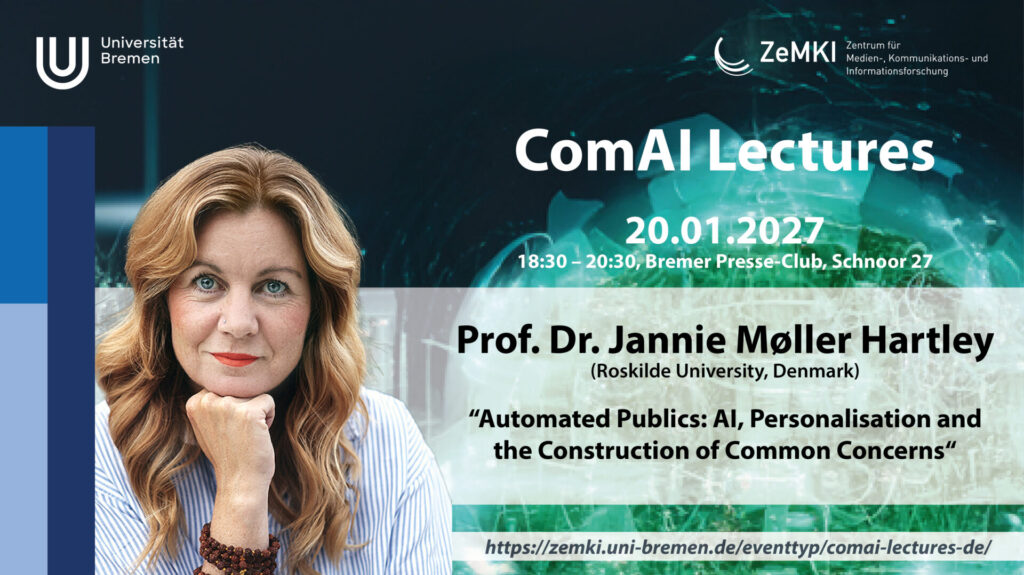
- Date: 20. January 2027
- Time: 18:30
- Street: Domshof 26, 28195 Bremen (Universität Bremen)
- Location: Forum im Domshof
- Room: Kassenhalle
Abstract
Shared matters of concern are fundamental to democratic life. Publics do not simply exist; they form around problems, controversies and consequences that come to matter. As Marres succinctly puts it: “no issue, no public.” But what happens when the conditions under which issues become visible, relevant and shared are increasingly organised by artificial intelligence?
Based on my new book ‘Just for You’: Inside the Personalisation Algorithms That Curate Our Image of the World’ (Nordicom 2026, OA) this keynote examines how AI, recommender systems and personalised information environments participate in the construction of public issues. Drawing on ethnographic research inside the “machine rooms” of news organisations developing personalisation algorithms and a historic genealogy of these algorithmic systems, I argue that they do much more than distribute already existing content to already existing audiences and publics. They encode ideas about relevance, newsworthiness and the user; organise pathways through information; and make some matters more visible while allowing others to recede. In doing so, they participate in carving out the conditions under which publics can emerge.
Bio
Jannie Møller Hartley is Professor and Ph.d. in Communication and Journalism. She is currently co-leading the Centre for big data at Roskilde University and the PI of the reasearch project DataPublics. She is also leading the research group ‘Journalism and Democracy’ with her colleage Eva Mayerhöfer. In her research she is situated in between the fields of Journalism Research, Audience Studies and Data Science. She is concerned with governance by algorithms, critical data studies, datafied everyday lives and the role of journalism in the age of datafication with a particular focus on democratic publics. She is researching the effect of reccommender systems, diversity in news distribution and algorithms in newsrooms. But she is combining this with research into citizen’s everyday lives with algorihmic and datafied media. She is a trained journalist and is the author of the book ‘News Online (In Danish: Nyheder på Internettet’ 2012) and is currently writing the book ‘Designing the News: Transformation of journalism and its publics in datafied societies’. She is a media sociologist and is methodologically using a wide range of both quantitative and qualitative methods, digital and non-digital. Furthermore she is involved in research project on #Metoo and the Media with Malmø University, Media, Covid and Climate Change (with University of Bergen) and a number of projects on press etchics and regulation with European collegues and researchers form the research group ‘Media and Democracy’ at RUC. As a journalist she is involved in the Centre for investigate Journalism and has just published a book on the methods of investigate journalism. Her particular interest is in the methods of Open Source Research (OSINT). She has published and is also served as reviewer in journals such as ‘New Media and Society’, Journalism Practice’, ‘Journalism Studies’, ‘Journalism’, Media Culture, ‘Journalistica’ and ‘Big data and Society’. She is on the editorial board of journals such as ‘Digital Journalism’, Social Media and Society’ and ‘Journalistica‘.
10. October 2026

Contact:
Prof. Dr. Andreas Hepp
ZeMKI, Center for Media, Communication and Information Research
University of Bremen
Phone: +49 421 218-67620
Assistent Mrs. Schober: +49 421 218-67603
E-mail: andreas.hepp@uni-bremen.de