Inside the Feed: How Data Donation Opens Up Political Behaviour on Social Media
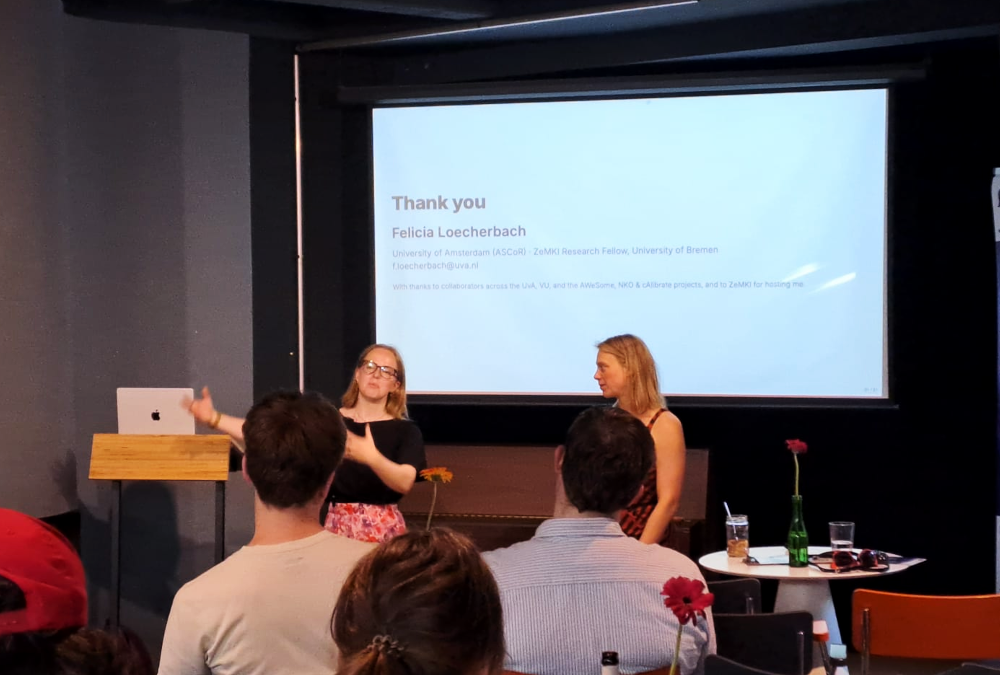
On 23 June 2026, Felicia Loecherbach (University of Amsterdam / NYU Center for Social Media and Politics) was a guest at the ComAI Lecture at the Bremer Presse-Club. Under the title “Inside the Feed. Data donation and political behaviour on social media,” she offered insights into a methodological field of growing importance: data donation as a way to access those traces of political information consumption that usually elude conventional research.
Loecherbach opened with a deceptively simple question: why is it actually so hard to understand who receives which information, and in what way? Social media and AI increasingly decide which content we see and which stays hidden — and which voices feel loud. Several features of today’s media environments make this research difficult:
- It is invisible: fast, fragmented, only half-remembered.
- It is personalized: every feed is unique.
- It is a black box: feeds are private or semi-private spaces that platforms do not open up to researchers.
- It is mixed with the private: information reaches us through the same channels we use for personal purposes.
On top of this, media systems keep growing more diverse — which only adds to the question of where researchers should even look. This is where the data donation approach comes in: the GDPR gives users the right to download their personal data — and they can donate it for research. Loecherbach and her team developed a user-friendly infrastructure that processes the data so that only the research-relevant, and precisely not the intimate, parts are shared. No one needs your entire WhatsApp history — just certain, clearly defined pieces of it. In this way, the team received data on browsing histories as well as YouTube, TikTok and AI usage. Notably, the team approached people not only online but deliberately offline as well — at events and festivals. There, the response was considerably more positive, because the online route involves complex processes for many users.
Loecherbach was candid that such data is no easy win. The sample is biased: of 9,523 requests opened, only 435 led to an actual donation — and those who stay are not representative (rather young, rather well-educated). The analysis is laborious, too, because the data is decidedly messy. And even then, meaning often remains open: a click can mean many things, as can time spent — much of it is simply accidental. The lecture thus offered not only a window into a promising methodological field, but also an honest reckoning with its conceptual, ethical and practical challenges — along with starting points for future collaborations in political communication and platform research.
24. June 2026
Contact:
Prof. Dr. Andreas Hepp
ZeMKI, Center for Media, Communication and Information Research
University of Bremen
Phone: +49 421 218-67620
Assistent Mrs. Schober: +49 421 218-67603
E-mail: andreas.hepp@uni-bremen.de