Prof. Dr. Axel Bruns (Queensland University of Technology, Brisbane, Australia): Revisiting ‘the’ Public Sphere and Its Algorithmically Shaped Publics
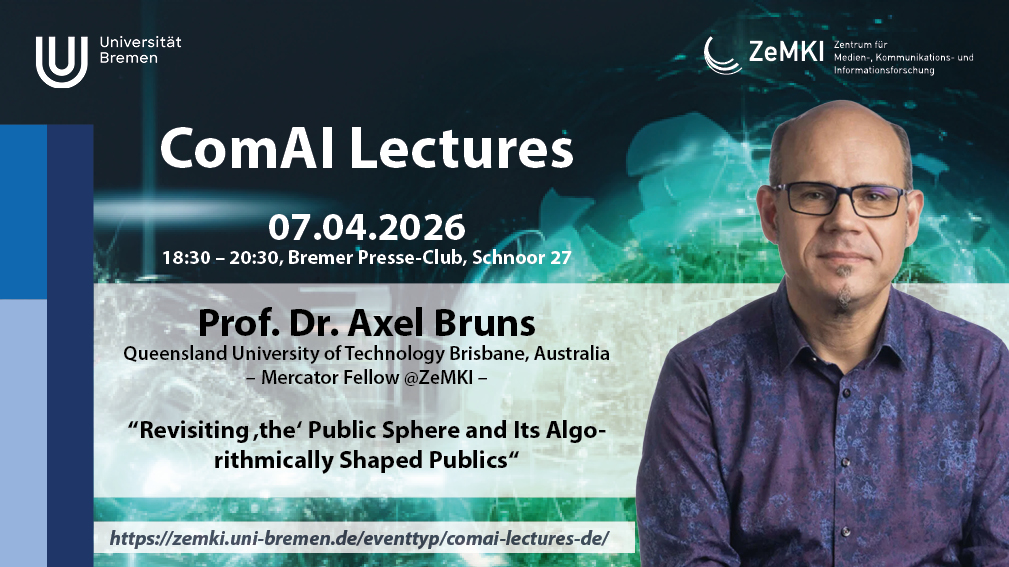
- Date: 7. April 2026
- Time: 18:30
- Street: Schnoor 27
- Location: Bremer Presse-Club
Bio
Axel Bruns is an Australian Laureate Fellow and Professor in the Digital Media Research Centre at Queensland University of Technology in Brisbane, Australia, and a Chief Investigator in the ARC Centre of Excellence for Automated Decision-Making and Society. His books include Are Filter Bubbles Real? (2019) and Gatewatching and News Curation: Journalism, Social Media, and the Public Sphere (2018), and the edited collections Digitizing Democracy (2019), the Routledge Companion to Social Media and Politics (2016), and Twitter and Society (2014). His current research focusses on the study of public communication in digital and social media environments, with particular attention to the dynamics of polarisation, partisanship, and problematic information, and their implications for our understanding of the contemporary public sphere; his work draws especially on innovative new methods for analysing ‘big social data’. He served as President of the Association of Internet Researchers in 2017–19. As of now, he is a Marcator Fellow at ZeMKI.
Revisiting ‘the’ Public Sphere and Its Algorithmically Shaped Publics
‘The’ public sphere is now irretrievably fractured into a multiplicity of online and offline, larger and smaller, more or less public spaces that frequently (and often serendipitously) overlap and intersect with one another, and that are increasingly shaped by algorithmic interventions. This diverse array of what have been described variously as public spheres, public spherules, platform publics, issue publics, or personal publics nonetheless serves many of the same functions that were postulated for the public sphere itself. However, while the communicative structures, functions, and dynamics of many such spaces have been studied in isolation, we still lack a more comprehensive model that connects such case studies in pursuit of an overarching perspective. This talk identifies the crucial building blocks that help us conceptualise and investigate how the network of such spaces is structured, and in turn structures our everyday experience of public communication.
20. March 2026

Contact:
Prof. Dr. Andreas Hepp
ZeMKI, Center for Media, Communication and Information Research
University of Bremen
Phone: +49 421 218-67620
Assistent Mrs. Schober: +49 421 218-67603
E-mail: andreas.hepp@uni-bremen.de