Media lecture on AI, copyright, and journalism
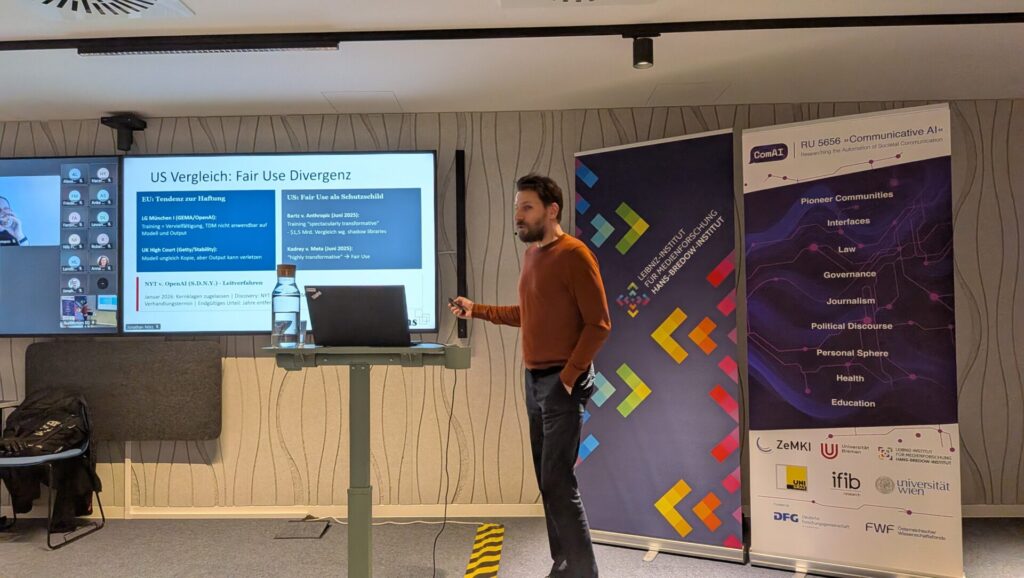
The Leibniz Media Lecture by legal scholar Prof. Dr. Philipp Hacker, LL. M. (Yale), on January 28 was a double premiere: Not only was it the first Media Lecture organized by the ComAI research group, but it was also the first public event held in the new premises of the Leibniz Institute for Media Research | Hans Bredow Institute on Warburgstraße in Hamburg.
At the invitation of subprojects P3 (Law) and P5 (Journalism) and in the spirit of interdisciplinarity, the legal scholar from the European University Viadrina spoke about the future of internet search and journalism – with a special focus on the changes brought about by chatbot use, website crawling, and LLM training with press products.
Special attention was paid to copyright law. Hacker first described the current cases currently being dealt with by courts in Germany and the European Union, and then analyzed how various aspects of the AI-based economy can be classified legally. In doing so, he asked questions such as: Are memorization processes in the context of training an AI language model a reproduction in the copyright sense? And what role does the text and data mining barrier established in European law play for operators of AI chatbots?
The presentation also highlighted the implications for various economic sectors, particularly journalism. Here, the speaker’s interdisciplinary perspective—which incorporated approaches from both law and computer science—proved particularly insightful in understanding the social dimensions of copyright issues in the context of AI. For example, considerations regarding the legally compliant implementation of opt-in or opt-out solutions showed that technical knowledge of crawlers and bots is also essential for this.
In addition to such approaches, new remuneration systems were also discussed, while at the same time the limits of (copyright) law were highlighted: without political will, Hacker argued, the journalism refinancing crisis, exacerbated by AI effects, threatens to turn into an epistemic crisis – with the result that the state itself might have to take over the provision of information services, similar to what it does with broadcasting. But examples from Italy and Belgium showed that political vision is also needed when it comes to remuneration systems. In view of the danger of structural market distortions in favor of large platforms, independent supervision and enforcement that remains effective even in tense international trade relations is also of crucial importance.
The Media Lecture met with great interest, with numerous questions and comments being directed at the speaker afterwards by both those attending in person and guests joining online. Not only were specific legal issues explored in depth, but empirical findings from journalism research were also included. Among other things, it became clear that interests in journalism vary and that a blanket opt-in solution would not be equally appropriate for all stakeholders. The evening concluded with a get-together in the addendum of the new auditorium, where open questions were discussed and guests were given a tour of the new HBI premises. The event offered both internal and external guests the opportunity to gain up-to-date insights into a topic of high social and legal relevance, while also experiencing how interdisciplinary exchange can productively combine different perspectives. We would like to thank Philipp Hacker for his stimulating input.
29. January 2026

Contact:
Prof. Dr. Andreas Hepp
ZeMKI, Center for Media, Communication and Information Research
University of Bremen
Phone: +49 421 218-67620
Assistent Mrs. Schober: +49 421 218-67603
E-mail: andreas.hepp@uni-bremen.de