AI, Agency, and Power Geometries – A Review of the Lecture by Prof. Dr. Simone Natale
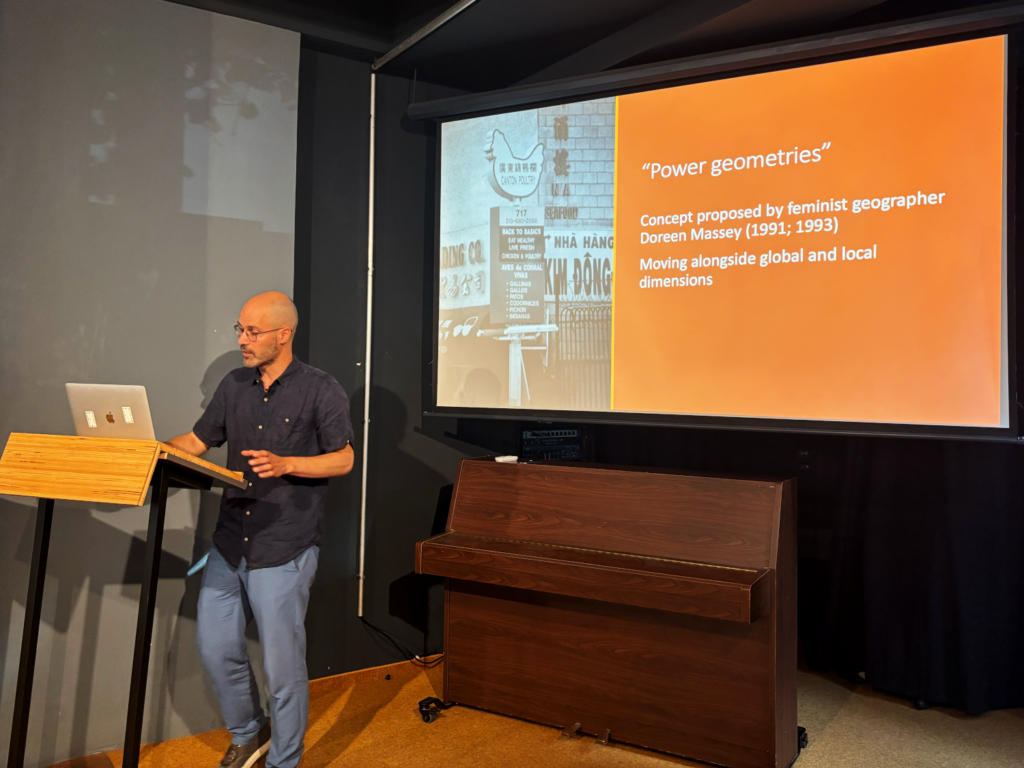
On 26 May 2026, Prof. Dr. Simone Natale (University of Turin) visited the Bremer Presse-Club to deliver a talk as part of the ComAI Lecture Series, drawing on his recent article “AI, Agency, and Power Geometries” (Media, Culture & Society, 2025).
Natale opened with a fundamental paradox: AI is a global phenomenon, yet it is always embedded in specific local contexts, cultures, and power relations. To address this tension theoretically, he proposed applying feminist geographer Doreen Massey’s concept of power geometries to the case of AI. Power geometries describe how mobility and spatiality are shaped by and produce structures of power – and how different actors occupy very different positions within those structures: some initiate flows and movements, others are mainly on the receiving end.
A central thread throughout the lecture was the cultural situatedness of AI. Training data is culturally shaped, and design decisions are made through culturally informed processes – something that manifests, for instance, in the specific linguistic patterns of generative language models. AI as a global phenomenon therefore cannot be understood apart from three key dimensions: the geopolitics of AI, global power asymmetries and postcolonial inequalities, and the global organization of (data) labor.
Closely connected to this is the question of agency – another key concept of the talk. Natale argued against treating agency as a fixed, binary property belonging either to humans or to machines. Instead, agency is distributed fluidly across actors of very different kinds: machines, users, corporations, governments, and institutions alike. This distribution is itself an expression of power relations, and makes visible that AI systems are not ahistorical, universal forces but are inscribed in specific cultural, historical, and geopolitical contexts.
The lecture offered a compelling framework for extending ComAI’s research perspective on communicative AI toward an explicitly global and postcolonial dimension. We warmly thank Prof. Dr. Natale for his visit to Bremen.
27. May 2026

Contact:
Prof. Dr. Andreas Hepp
ZeMKI, Center for Media, Communication and Information Research
University of Bremen
Phone: +49 421 218-67620
Assistent Mrs. Schober: +49 421 218-67603
E-mail: andreas.hepp@uni-bremen.de