Axel Bruns at ComAI: From “the” public sphere to a network of publics
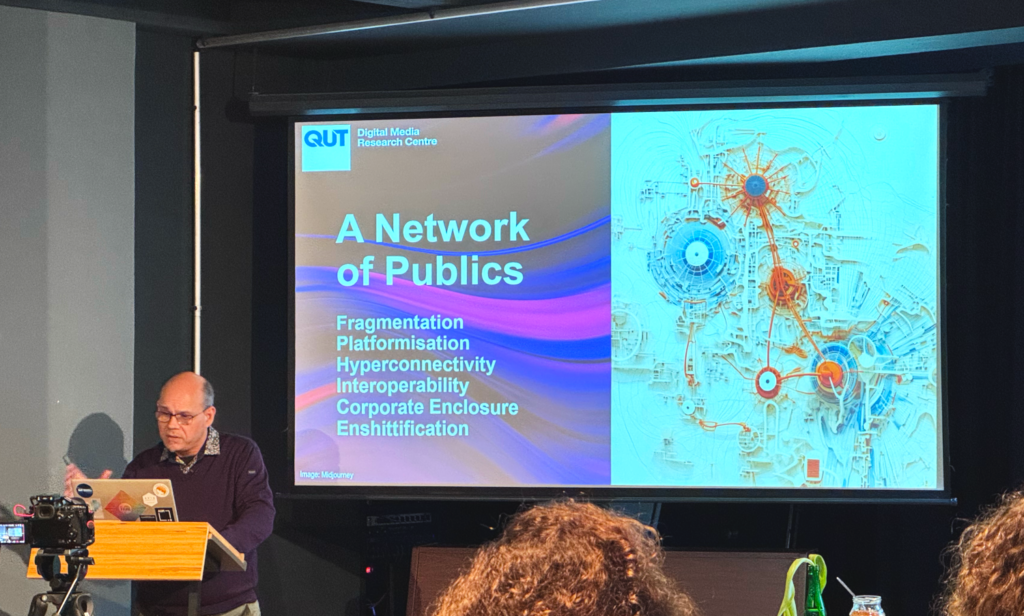
As part of the ComAI Lectures series, communication and media scholar Axel Bruns visited the Bremer Presse-Club on April 7. Bruns, currently a Mercator Fellow at ZeMKI, presented a conceptual framework titled “Revisiting ‘the’ Public Sphere and its algorithmically shaped publics” that fundamentally challenges the classical Habermasian notion of a unified public sphere, replacing it with an empirically grounded model of networked publics.
The talk built on Bruns’ 2023 article in Communication Theory, “From ‘the’ public sphere to a network of publics,” expanding its ideas toward a new book on the subject. His central argument: the “the” in “the public sphere” is no longer tenable – “public” in reality describes a spectrum between public, semi-public, and private, and the “sphere” is not a unified space but a network of spaces with distinct structures and dynamics.
Bruns developed a typology of communicative formations that serve as the building blocks of this network: from personal publics as ego-centric communication networks of individuals, through issue publics that form around specific topics or events, to public spherules in which related thematic publics coalesce into broader discursive formations. Crucially, these formations do not stand in a hierarchical relationship but form a horizontally and vertically networked structure, shaped by features such as fragmentation, platformization, hyperconnectivity, and interoperability, but also by corporate enclosure and enshittification.
A particular focus lay on the role of algorithms. Bruns distinguished between “algorithms from above” – platform-side mechanisms of visibility management, moderation, and recommendation – and “algorithms from below,” referring to automated actors within communicative spaces such as bots, AI-generated content, and automated response patterns. Both levels shape the structures and dynamics of publics in platform-specific ways.
Bruns emphasized the democratic-theoretical relevance of this perspective: if “the” single public sphere no longer exists, the question of how democratic opinion formation can function within such a network of fragmented, algorithmically shaped spaces becomes all the more pressing. Concepts and terminology, Bruns argued, are far from mere academic exercises – they render complex phenomena intelligible, provide a common language for analysis, and inform practical action in policy and business.
The lecture offered important points of connection for the work of the ComAI research group: the model of networked, algorithmically shaped publics sharpens our view of the communicative spaces in which communicative AI is increasingly unfolding and co-shaping public debate.
8. April 2026

Contact:
Prof. Dr. Andreas Hepp
ZeMKI, Center for Media, Communication and Information Research
University of Bremen
Phone: +49 421 218-67620
Assistent Mrs. Schober: +49 421 218-67603
E-mail: andreas.hepp@uni-bremen.de